
Prop Firm Software: Platform, Risk, Payments & CRM
Updated
Prop firm software connects the systems behind an evaluation business: checkout, trading-account access, programme rules, CRM records, trader dashboards and reward operations. Evaluate the complete account journey, including the handovers to external providers and the decisions your team remains responsible for.
Use this overview to scope a PropFirmsTech implementation for a new firm or a migration, then follow the proposed workflows in a platform demo. The CRM and trader dashboard page focuses on daily staff and customer tasks; this page covers how the wider stack connects and who owns each part.
Start with the trader's view of the platform
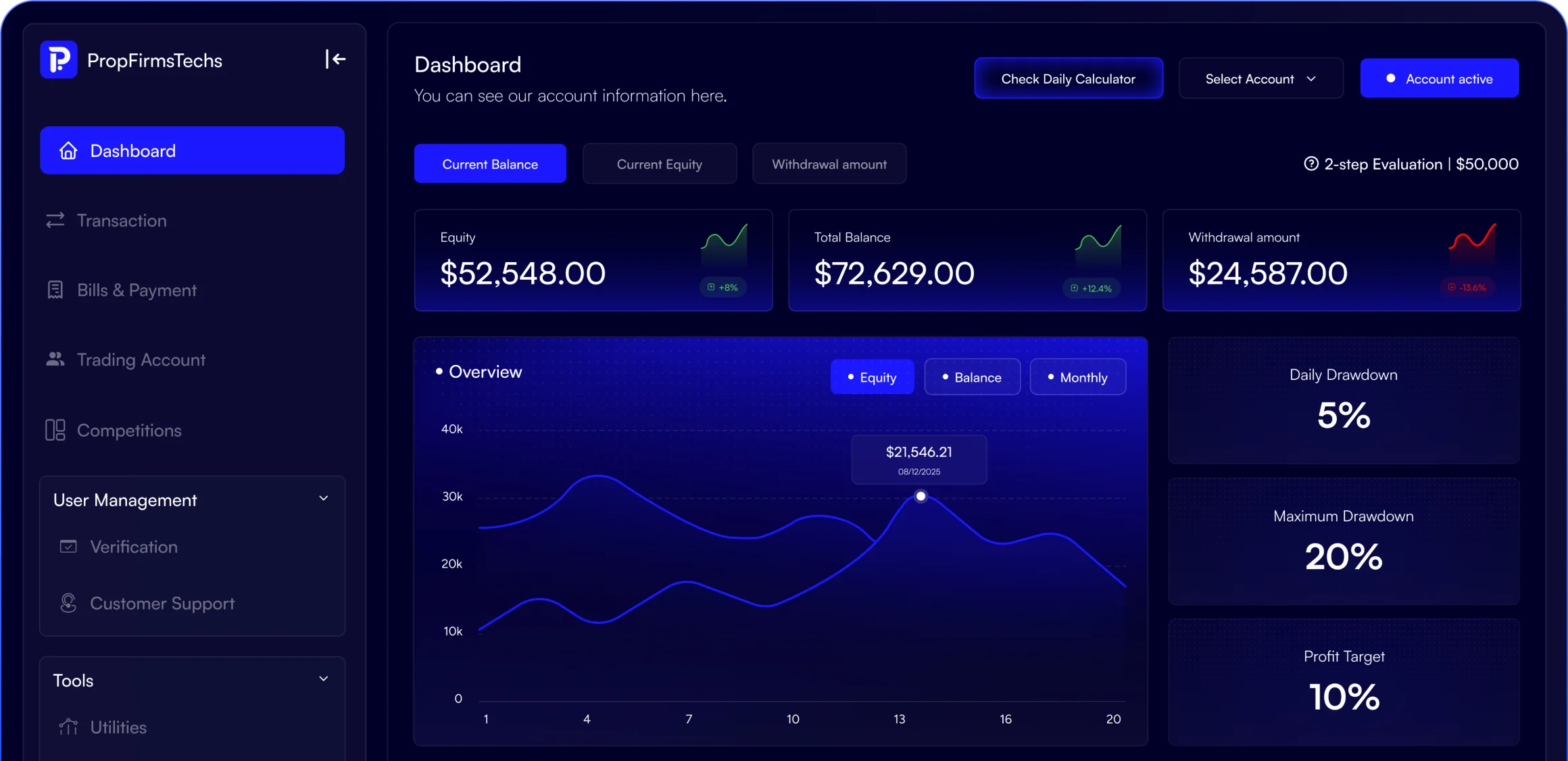
The PFT dashboard preview shows account selection, balance and equity charts, and programme objectives. Use it to identify the information your traders need, then ask the demo team to trace where each status and calculation comes from. A complete software evaluation connects that view to the order, platform account and operator record.
The modules to evaluate
Trading platform access
Start with the platform, instruments and markets you intend to serve. Discuss MetaTrader 5 and the alternative platform integrations, including Match-Trader and DXtrade. Confirm licensing or vendor permissions, account provisioning and the hosting arrangement in the proposed package.
Programme configuration and risk monitoring
Define evaluation phases, targets, daily and overall loss calculations, consistency conditions and the actions taken when a rule is met or breached. Ask to see the configured rule alongside its dashboard calculation, including a daily reset and an open-loss example. The risk management overview explains this part of the stack.
Checkout, payments and reward operations
The payment layer connects purchases to orders and account activation; the reward workflow connects requests to review and payment status. Confirm which providers can onboard your entity and support your intended countries, currencies and payment methods. Approval and settlement depend on the provider; routing cannot guarantee that every card is accepted. See the payment integration overview and use the payout reconciliation checklist to define approval, instruction, provider outcome and finance evidence separately.
Identity checks, CRM and trader dashboard
KYC and screening integrations support your verification process; they do not, by themselves, establish compliance with every obligation that applies to the business. Agree the provider, review process and account actions with the appropriate advisers and operations team.
The CRM and trader dashboard connect onboarding, accounts, support, affiliates and reward requests. Confirm which records and actions are supported in your configuration. For white-label configuration, identify the surfaces to brand. Review customer emails, third-party payment pages and documents as well as the dashboard.
Agree who owns each handover
Use this proposed responsibility matrix to prepare the implementation discussion. Name your firm's decision owner, PFT's delivery responsibilities and the relevant external provider for each row. Confirm what the proposal covers and what needs another agreement; the table is not a universal list of included or optional features.
| Workstream | Your firm's inputs and decisions | Confirm in your proposal |
|---|---|---|
| Programme and rule configuration | Supply programme versions, terms, calculation examples and approved exceptions. | Identify configuration work, supported calculations, rule-data sources and acceptance tests. |
| Platform access and provisioning | Specify markets, instruments, account types and required staff actions. | Confirm platform availability, licensing/permissions, hosting, API access and the provisioning owner. |
| Checkout and reward payments | Define order policy, reward approvals and the finance reconciliation process. | Identify eligible provider options, external onboarding, instruction/status mapping and exception ownership. |
| Identity, CRM and branding | Specify review policy, staff roles and the customer surfaces to brand. | Agree provider handovers, role permissions, CRM/dashboard scope and external branding limits. |
| Migration and ongoing operations | Supply source records, accept reconciliations and name release/escalation owners. | Agree import/export coverage, cutover, monitoring, support, maintenance and exit responsibilities. |
Test the connections, including an interrupted handover
Prepare one synthetic account journey rather than separate demonstrations of disconnected modules. Agree which records you can retain for review and which proposed connections need provider approval or implementation work.
- Purchase and provision. Start with an order and follow the provider result into account creation. Record the order and account identifiers, the activation condition and the recovery owner if the platform does not respond. A successful payment alone is not proof of access.
- Calculate and transition. Supply a programme version with expected targets and loss boundaries. Compare the rule decision with the CRM and trader dashboard, including a daily reset or open-position example. Keep the inputs, expected result and observed state together.
- Review and reconcile. Follow a reward request through eligibility, staff approval, provider instruction and confirmed outcome. Record the references and unresolved states your finance team needs; agree what happens after a rejected or unknown provider response.
- Export and hand over. Request a sample of the agreed trader, order and account records with field definitions. Name who resolves missing references, who accepts reconciliation and how operations recover if a launch or migration check fails.
These are acceptance cases to agree for your configuration, not claims that every integration is included. Use the API integration checklist to record the source of truth, retries and owner at each boundary. Use the payout reconciliation checklist for payment outcomes and the CRM scorecard for operator permissions and workflow evidence.
Build, buy or connect an existing stack?
An in-house system gives you control over its development, with ongoing responsibility for maintenance, integrations, security and operations. A supplied platform provides an existing set of modules, with configuration and integration work defined in the contract. Compare both against the workflows you need, the resources you have and the data access you require.
Use the in-house technology guide and startup cost breakdown to prepare questions. A headline software fee is only part of the operating budget; allow for provider charges, staffing and the responsibilities that remain with your firm.
Plan a launch or migration
For a new firm, agree the brand assets, programme definitions, provider onboarding, website content and test cases before setting the go-live date. For a migration, also map existing trader records, account states, orders, affiliate attribution and pending rewards. Reconcile sample records before the cutover and agree how to handle a failed migration.
The platform migration guide provides a planning checklist. The launch guide covers the wider business preparation. Neither a software purchase nor a target delivery date removes the need for those checks.
Download the migration reconciliation template (CSV) to map source and destination references, opening balances and exception owners. Its labelled synthetic examples are planning aids; replace them with reviewed records and keep unresolved differences visible before accepting the cutover.
Pricing, delivery and support scope
Request a current written quote identifying the trading platform arrangement, modules, third-party charges, implementation work and support coverage. Specify the account/usage assumptions behind recurring fees. Confirm escalation contacts, maintenance arrangements, data access and the responsibilities of each team, including any work outside the proposed package.
Agree the release gates: scope accepted, required providers ready, account and payment workflows tested, records reconciled and operators prepared. Confirm the delivery plan against those dependencies rather than assuming provider approval or a fixed launch time.
Frequently asked questions
What is prop firm software?
Prop firm software connects the systems used to sell and operate evaluation or funded-stage programmes: trading-platform access, account provisioning, rule calculations, orders, reward operations and customer access. Scope the required workflows and provider connections for your firm, then verify them in the proposed implementation.
How is prop firm software different from a prop firm CRM?
The CRM is the staff workspace for trader relationships and account operations; the dashboard is the trader-facing view. The wider software scope also covers the trading-platform connection, rule engine, checkout, external providers, hosting and integration responsibilities. A CRM demo alone does not establish every part of that scope.
How much does PropFirmsTech software cost?
Request a current written quote for your programme, platforms and required workflows. Ask which setup, recurring, usage, provider, implementation and support charges apply. Identify assumptions, external contracts, migration and exit work so proposals can be compared on the same scope.
Which trading platforms should I discuss in a demo?
Bring your MetaTrader 5, Match-Trader, DXtrade, cTrader or TradeLocker requirements to the demo. Confirm the supported integration, vendor permissions, hosting arrangement and availability for your markets in the proposed package before committing.
What determines a launch or migration date?
Agree the required scope, programme definitions, brand assets, provider approvals, test evidence and operator handover. A migration also needs accepted record mappings, reconciliation, cutover and recovery plans. Set the release date against those dependencies and acceptance decisions rather than assuming every project has the same timeline.
Book a software demo and bring your programme rules, platform requirements and launch or migration questions.